Ripplefold Sheers and the Return of Layered Light
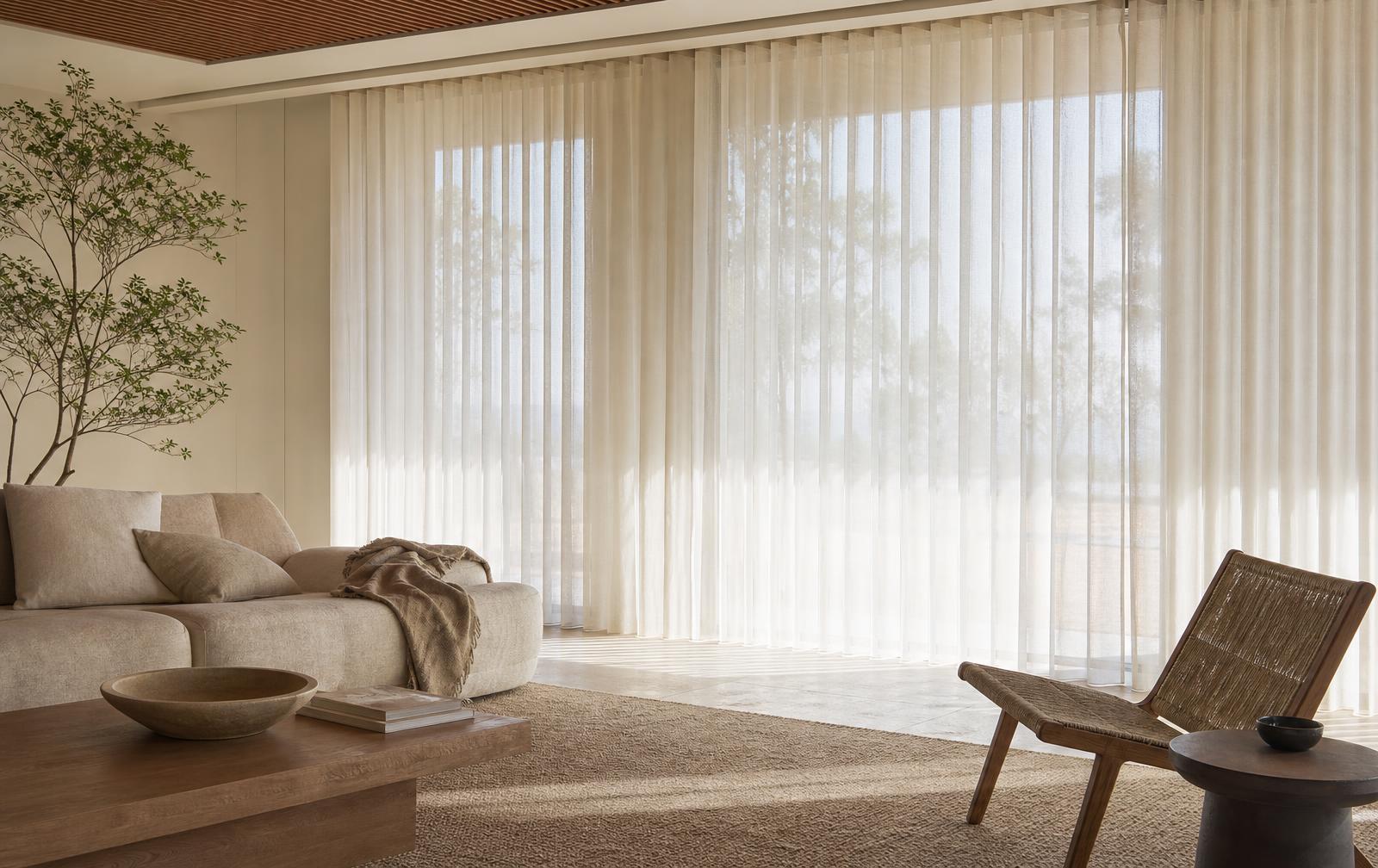
The most requested drapery detail in our workroom this year is not a pleat at all. It is ripplefold, in a sheer, running wall to wall on a ceiling mounted track. The look has moved out of hospitality and commercial work and into residential projects where the architecture is doing the talking and the window treatment is asked to soften rather than decorate.
Why the detail suits current interiors
Ripplefold produces a continuous, even undulation with no heading hardware visible and no pleat to interrupt the rhythm. On a sheer, that uniformity turns a window wall into a plane of diffused light. It reads architectural rather than traditional, which is exactly why it pairs so well with the plaster, oak, and stone palettes running through Denver and mountain projects right now.
It is also practical. The carriers glide, the panel stacks tightly, and there is no pleat to crush when the drapery is drawn every day. For a family room used constantly, that durability matters more than clients expect.
Fullness is the decision that makes or breaks it
Ripplefold fullness is set by snap tape spacing, typically between sixty and one hundred and twenty percent. Lower fullness gives a shallow, taut wave and a very small stack. Higher fullness gives a deeper, more luxurious wave and a stack that needs real wall to live in. On sheers, we generally recommend the middle to upper range, because a thin fabric at low fullness can look sparse when backlit. Decide fullness with the stack space measured, not estimated.
Track, ceiling, and the pocket question
Ceiling mounted track is what makes the detail disappear, and it is worth the coordination. If the ceiling is being built, ask for a recessed pocket sized to the track and the wave depth so the fabric can move without brushing the drywall return. If the ceiling exists, a low profile surface mounted track finished to match the ceiling color reads almost as clean. Either way, the track must be level across the entire run, since ripplefold shows a sagging track more clearly than any pleated panel will.
Layering without heaviness
The strongest version of this look pairs the sheer ripplefold with a second layer that handles privacy and blackout, usually a roller shade or a flat roman behind it, or a pleated drapery on an outer rod. Keep the layers in different registers. If the sheer is doing texture, let the opaque layer be quiet. Two competing textures in the same opening reads busy in a way photographs never quite capture.
What we need on the order
Send us the finished track length, the return conditions, the stack side, the desired fullness percentage, and the finished length measured from the track rather than the ceiling. Sheers hang long, so specify whether the client wants a light break, a kiss to the floor, or a puddle. On a wall of glass, half an inch of inconsistency is visible from across the room, which is why we measure the finished length after the track is set whenever the schedule allows.
Roseworks Fabrication fabricates ripplefold sheers and layered drapery systems for trade partners across Colorado. Bring us the elevation early and we will help you resolve the pocket, the stack, and the fullness before the fabric is ordered.