How Hardware Selection Impacts Drapery Design and Function
Hardware and fabric are not independent choices. The pole you select affects how the fabric hangs. The ring diameter determines how smoothly the panels traverse. The bracket projection controls whether the drapery clears the window frame. The finial style sets the visual tone for the entire treatment.
Designers who think of hardware as a late-stage decision often end up with panels that do not operate as intended or a visual disconnect between the treatment and the architecture. This guide covers the key relationships between hardware and drapery that should inform your specification from the start.
Pole Diameter and Visual Weight
The diameter of the pole establishes the visual weight of the hardware in the room. A 1-3/8" diameter pole reads as standard and appropriate for most residential applications. A 2" diameter pole reads as substantial and makes a stronger design statement. A 3/4" diameter pole reads as delicate and works in spaces where the hardware should recede.
The pole diameter also affects how rings sit and how the drapery header relates to the hardware. Larger poles require larger rings, which increase the gap between the top of the drapery and the pole. Smaller poles bring the header closer to the hardware for a tighter, more tailored look.
Design tip: Match pole diameter to the scale of the room. High ceilings and large windows can handle heavier hardware. Small rooms and low ceilings benefit from slimmer profiles.
Ring Size and Traversing
Ring inner diameter must be at least 1/4" larger than the pole diameter for smooth traversing. Rings that are too tight bind on the pole and make opening and closing the drapery difficult. Rings that are too loose create an uneven hang and audible rattling.
The ring style also matters. Simple round rings are the most versatile and disappear visually. Rings with decorative details (fluting, faceted edges, or wrapped finishes) add visual interest but can slow traversing slightly on textured poles.
For panels that will be opened and closed daily, prioritize smooth operation. For stationary panels, ring style can be chosen purely on aesthetics.
Projection and Clearance
Bracket projection determines how far the pole sits from the wall. This distance must accommodate:
- The window frame depth (the drapery must clear the frame when traversing)
- Any blinds or shades mounted inside the frame (the drapery must not press against them)
- The return of the drapery panel (the fabric that wraps from the front of the pole back to the wall)
Insufficient projection is one of the most common hardware specification errors. The drapery looks crowded against the wall, does not traverse smoothly, and the return fabric bunches rather than lying flat.
Specification tip: Measure the total depth from the wall to the outermost point the drapery needs to clear (window frame, blinds, or molding), then add at least 1" for clearance. Specify a bracket with at least that much projection.
Stack-Back Space
When drapery panels are fully open, they stack against the wall on either side of the window. The space the stacked panels occupy is called the stack-back. If you do not account for stack-back, the open panels will cover a portion of the window glass, reducing light and view.
The amount of stack-back depends on:
- Fabric weight and fullness (heavier, fuller panels stack deeper)
- Pleat style (pinch pleats stack deeper than ripple fold)
- Number of layers (sheers behind drapery double the stack)
Design tip: Extend the pole beyond the window frame on each side by an amount equal to the expected stack-back. This allows the panels to clear the glass completely when open. For a standard double-width panel (2.5x fullness), plan for approximately 12 to 18 inches of stack on each side.
Finials and Design Language
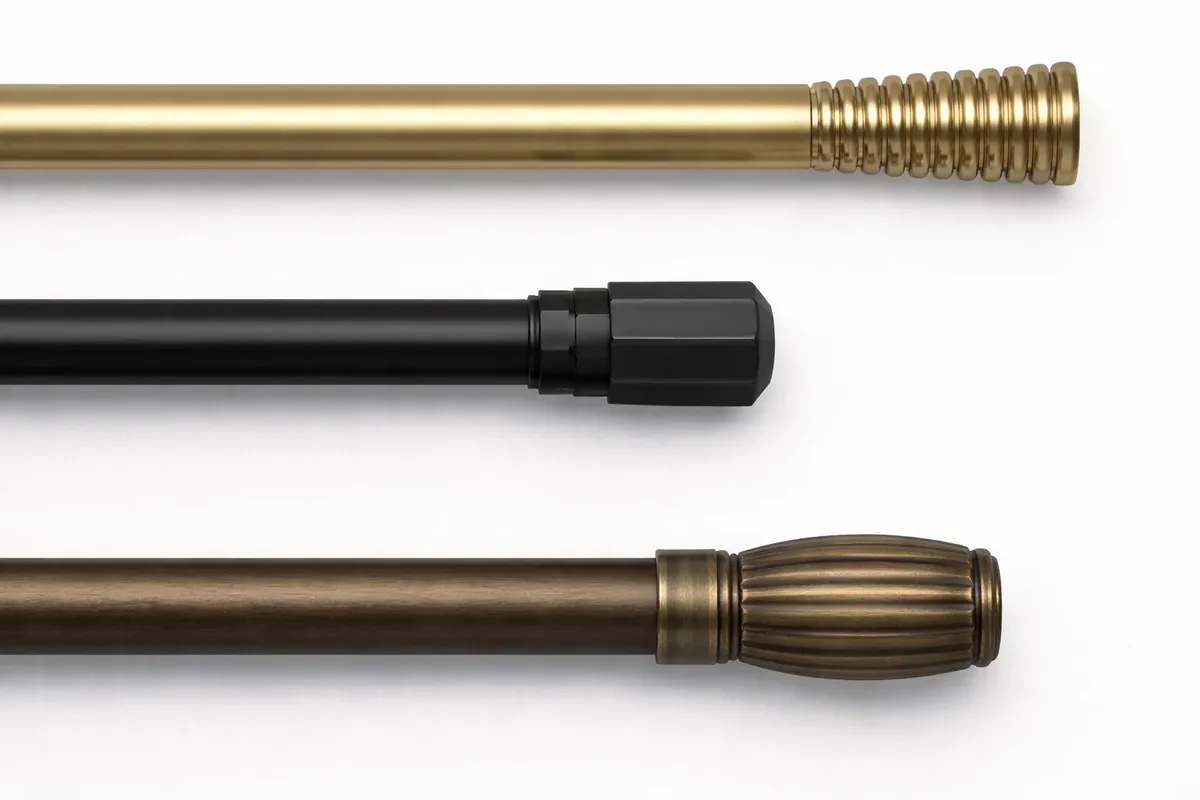
Finials are the visual punctuation of the hardware. They range from simple end caps to elaborate sculptural forms. The finial should relate to the design language of the room:
- Minimal end caps or bullet finials for modern and contemporary spaces
- Ball or sphere finials for transitional and classic interiors
- Urn, acorn, or leaf finials for traditional and formal rooms
- Crystal or faceted finials for glamorous and decorative spaces
Finials are small but disproportionately impactful. They are at eye level and visible from across the room. Choose intentionally.
The Integrated Approach
The best results come from specifying hardware and drapery together as a single design element. When the pole finish complements the fabric tone, the ring size allows effortless operation, the projection provides proper clearance, and the finials speak the same design language as the room, the window treatment feels intentional and complete.
At Roseworks, we carry over 16 hardware collections with more than 20 finishes. We can help you match hardware to your drapery specification or bring samples to your project site for in-context evaluation. Browse our hardware collections or schedule a showroom visit.
Related: The Definitive Guide to Drapery Hardware | Motorized Drapery Tracks: Specification Guide