The Definitive Guide to Drapery Hardware: Collections, Finishes, and Specifications
Drapery hardware is the structural and visual framework that supports your window treatment. The hardware you select determines how the drapery hangs, how it operates, and how it contributes to the overall design of the room. A beautifully fabricated panel on the wrong hardware is a missed opportunity. The right hardware elevates both the drapery and the architecture it lives within.
At Roseworks Fabrication, we carry over 16 exclusive hardware collections with more than 20 finishes. This guide walks through the key hardware categories, how to choose between them, and what to specify when placing an order.
Hardware Categories
Drapery hardware falls into three primary categories: decorative poles, functional tracks, and motorized systems. Each serves a different purpose and creates a different visual impression.
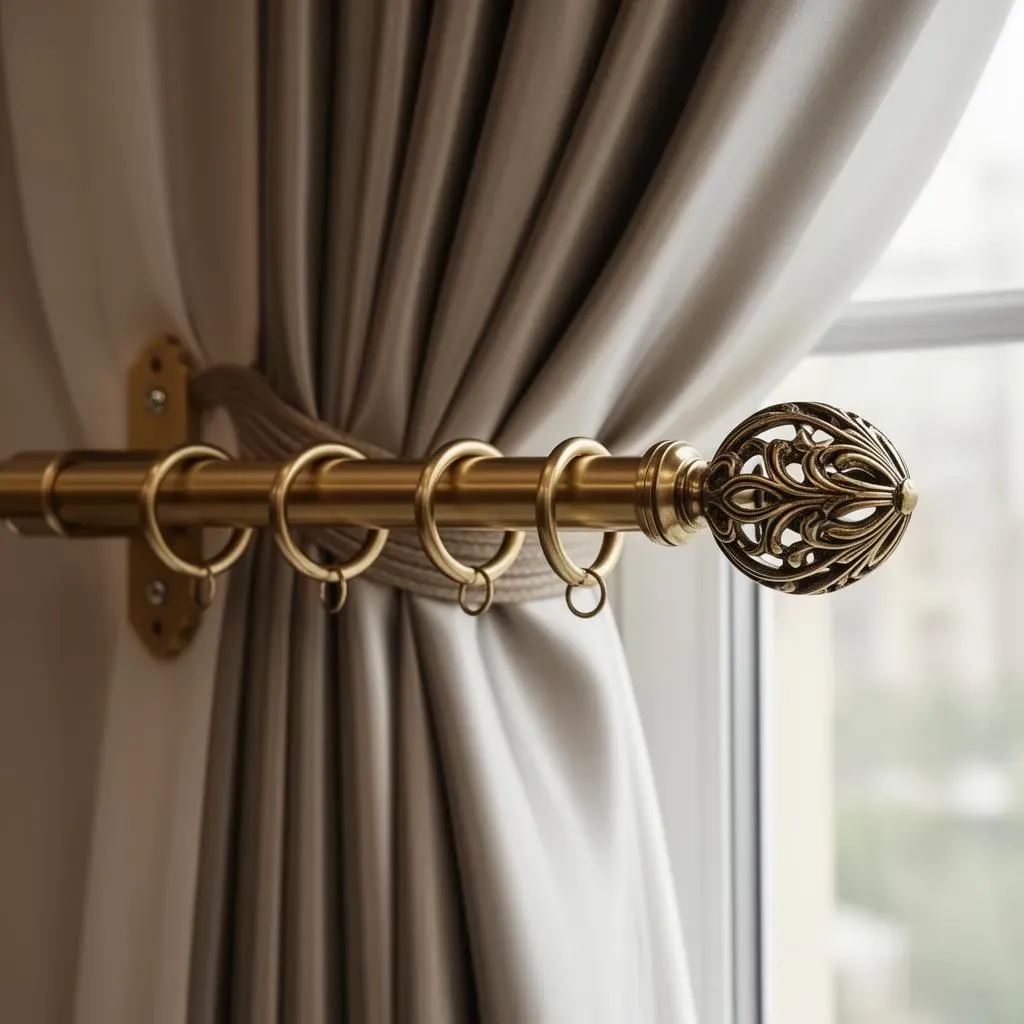
Decorative poles are the most visible hardware option. A pole, typically made of metal, wood, or acrylic, spans the width of the window and is supported by brackets mounted to the wall or ceiling. Drapery hangs from the pole using rings, clips, or a rod pocket sewn into the header. Decorative poles are finished with finials at each end, which serve as the design accent.
Poles are the right choice when the hardware itself is part of the design statement. In rooms with high ceilings, architectural trim, or traditional to transitional styling, a well-chosen pole with distinctive finials can be as impactful as the drapery it supports.
Functional tracks are concealed or low-profile systems designed for smooth traversing operation. The drapery glides along a track using carriers or gliders, allowing panels to open and close with minimal effort. Tracks can be ceiling-mounted or wall-mounted and are typically hidden behind the drapery header or within a recessed pocket.
Tracks are the right choice when the focus should be entirely on the fabric, not the hardware. Modern and contemporary interiors, ripple fold installations, and any application where clean lines matter benefit from a track system.
Motorized systems replace manual operation with electric motors that open and close the drapery via remote control, wall switch, or smart home integration. Motorized tracks are available in both exposed and concealed profiles. They integrate with platforms like Lutron, Somfy, and others.
Motorized systems are the right choice for hard-to-reach windows, large or heavy panels, smart home environments, and any application where convenience and automation matter.
Understanding Pole Materials
Steel tubing is the most common pole material. Available in round and square profiles, steel poles offer a wide range of finish options (chrome, satin nickel, polished chrome, stainless steel, bronze, gold, matte black, and more). Steel is strong, durable, and suitable for most residential applications.
Wrought iron delivers a heavier, more artisanal aesthetic. Wrought iron poles often feature hand-forged finials and decorative brackets. They work beautifully in rustic, Mediterranean, and traditional interiors.
Solid wood poles offer warmth and organic texture. Available in species like oak, walnut, and maple, wood poles can be stained or painted to match interior millwork. They pair naturally with linen and cotton draperies.
Aluminum is the standard material for tracks and motorized systems. Lightweight, strong, and available in multiple profiles, aluminum tracks are designed for smooth, quiet operation.
Finishes and How to Choose
Hardware finish should relate to the room's existing metal tones. Door handles, cabinet pulls, light fixtures, and furniture hardware all establish a metal language in the space. Your drapery hardware should speak the same language.
General guidance:
- Polished chrome and satin nickel work in contemporary and transitional spaces. Clean, cool, and versatile.
- Brushed bronze and antique bronze suit traditional, rustic, and warm-toned interiors. They pair well with warm wood floors and earth-tone palettes.
- Matte black is the current favorite in modern and industrial spaces. It reads as both bold and neutral, pairing with almost any fabric.
- Gold and brass have returned strongly in residential design. They add warmth and elegance, particularly in rooms with warm lighting and rich textiles.
- Stainless steel offers a commercial, architectural feel. Best for modern interiors with clean lines and minimal ornamentation.
- White and ivory finishes disappear against light walls, putting all visual emphasis on the fabric. Commonly used in relaxed, coastal, and Scandinavian-inspired interiors.
When in doubt, pull the finish from the most prominent metal element in the room. Consistency in metal tones is one of the simplest ways to make a room feel designed rather than assembled.
Rings, Carriers, and Attachment Methods
How the drapery attaches to the hardware affects both function and appearance.
Rings with pins or clips allow the drapery to slide freely along a pole. The rings are visible and become part of the hardware's visual impact. Ring diameter should be large enough for smooth traversing, typically at least 1/4 inch larger than the pole diameter.
Traverse rods use internal carriers that are concealed behind the drapery header. The fabric appears to float along the rod with no visible attachment mechanism. This creates a cleaner look than rings.
Ripple fold carriers are specific to track systems. They maintain uniform fold spacing and create the continuous wave that defines ripple fold drapery. The carrier spacing (typically 3 or 4 inches) determines the fold density.
Rod pocket and tab top headers thread directly onto the pole, eliminating rings entirely. These create a gathered, casual appearance and are best for stationary panels that do not need to traverse.
Brackets and Mounting
Brackets support the pole or track and determine its position relative to the wall and ceiling. Bracket selection affects:
- Projection: How far the hardware sits from the wall. Sufficient projection is critical to allow the drapery to clear the window frame, any blinds or shades behind it, and the wall itself.
- Stack space: Where the panels rest when fully open. Brackets positioned too close to the window edge do not leave enough room for the drapery to stack without blocking the glass.
- Ceiling vs. wall mount: Ceiling-mounted hardware draws the eye upward and makes ceilings feel taller. Wall-mounted hardware is standard for most applications.
Specifying Hardware for Your Order
When submitting a hardware specification to Roseworks, include:
- Collection name or product line
- Finish
- Pole diameter (if applicable)
- Pole length (or window width for us to calculate)
- Finial style
- Ring type and size (if applicable)
- Bracket type and projection
- Mounting method (wall or ceiling)
- Number of support brackets (for wide spans)
- Motorization requirements (if applicable)
If you are unsure which collection or finish is right for your project, visit our Westminster showroom to see the full range in person or contact our team for guidance.
Our Collections
We carry over 16 exclusive hardware collections including Steel, Lafayette, Acero, Gramercy, Wrought Iron, Royal Wood, Lenox, Bowery, Carnegie, Madison, Swarovski, Lincoln, Lexington, Tribeca, Custom Track, and Motorized Track. Each collection is available in multiple finishes and compatible with a range of drapery styles.
Browse the full collection on our Drapery Hardware page.
Hardware and Drapery: Designed Together
Hardware is not an afterthought. The pole, the rings, the brackets, and the finials are all part of the design. When hardware and drapery are specified together, the result is a window treatment that works as a single, cohesive element rather than two separate components bolted together.
For guidance on how hardware selection affects drapery design, see: How Hardware Selection Impacts Drapery Design and Function.
Ready to explore hardware options? Visit our showroom or browse our collections.
For the broader trade workflow context, see how Roseworks Fabrication supports trade professionals from specification to install.