Highland Park Bedroom: Designer-Specified Roman Shades and Coordinated Bedding
The bedroom is the residential room where soft goods coordination pays off most visibly. Window treatments, bedding, accent pillows, and sometimes upholstered furniture all occupy the same tightly defined visual field. A bedroom where each element was specified independently looks close but not quite right. A bedroom where the full soft goods palette was designed as a single composition looks intentional, layered, and complete.
This Highland Park bedroom project illustrates what coordinated bedroom fabrication produces when the designer specifies the full scope and the workroom executes the specification consistently across categories. The project included custom roman shades on the bedroom windows, a complete custom bedding set for the primary bed, and coordinated accent pillows that pulled the palette into the room''s decorative layer. Every element was specified together and fabricated together at the Roseworks workroom.
The Design Context
Highland Park in Denver is known for its residential architecture combining classic American residential forms with contemporary interior design sensibilities. The neighborhood''s homes support design vocabularies that range from traditional to transitional to modern, often within the same home as different rooms take on different character.
For this bedroom project, the design direction leaned toward transitional. The room''s architectural context included clean window millwork, modern lighting, and a bed wall that anchored the primary visual composition. The design called for soft goods that would reinforce the transitional character without pushing the room fully traditional or fully contemporary.
The palette worked in a family of warm neutrals with a secondary accent tone that appeared in carefully specified placements. The primary color direction supported the architectural context. The accent tone provided the compositional punctuation that prevented the room from reading as too quiet.
The Roman Shade Specification
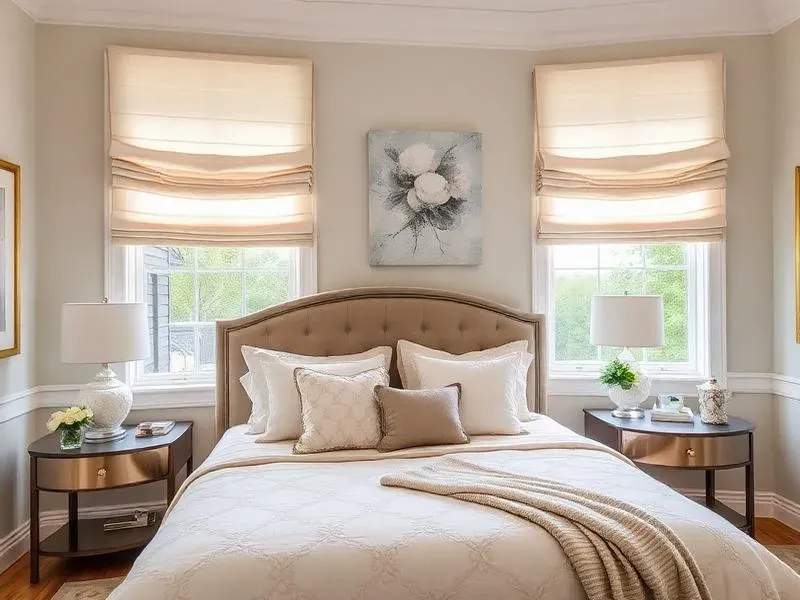
The bedroom windows called for roman shades in a soft fold construction. Soft fold roman shades read as softer and less architectural than flat roman shades, which matched the bedroom''s transitional direction. The construction produces a graceful cascade of horizontal folds when the shade is partially raised, with the folds holding their shape rather than hanging flat.
The shade fabric carried the primary palette tone in a medium-weight textured weave. The fabric had enough texture to add visible interest at close inspection while reading as quiet from across the room. The weave character coordinated with the room''s other soft surfaces without matching any of them directly.
Lining was specified as blackout. Primary bedrooms benefit significantly from full light control for sleep quality, and the blackout lining was a baseline functional specification rather than an aesthetic decision. The lining added weight to the shades, which contributed to the soft fold construction''s ability to hold its shape cleanly.
Mount type was inside mount where the window casing depth allowed, which produced a cleaner architectural appearance at the window openings. The shade headrails sit inside the casings with minimum visible hardware, which preserves the window millwork as the architectural element rather than the shade hardware.
Lift mechanism was cordless, specified for both safety and operational simplicity. Primary bedroom window treatments benefit from cordless construction particularly in homes with children or pets where hanging cords represent a hazard.
The Custom Bedding Specification
The bed anchored the room''s visual composition. The custom bedding scope included a duvet cover, four coordinating shams (two standard and two Euro), a tailored bed skirt, and four accent pillows in two scale points.
The duvet cover was fabricated in a supporting palette fabric with a subtly different texture than the shade fabric. The duvet carried the room''s broader neutral tone while providing a visual relationship to the shade without matching it. Construction included an invisible zipper closure along one side, hidden from view when the bed is dressed.
The standard shams coordinated with the duvet cover in a complementary fabric with a small-scale pattern. The shams added the first layer of pattern into the bedroom composition. Pattern matching across the pair was handled at the cutting table, and the shams were fabricated with flanged edges that produced the tailored finish the design called for.
The Euro shams used a different fabric with a larger-scale pattern that sat behind the standard shams in the layered bedding composition. The Euro shams introduced the accent palette tone into the bedroom as a secondary layer.
The tailored bed skirt was constructed with a flat panel design and corner pleats that produced a crisp, modern line appropriate to the transitional direction. The skirt fabric coordinated with the duvet cover but in a slightly different weight, which allowed the skirt to read as structural rather than decorative.
The accent pillows in two scale points introduced the final palette tones. A pair of rectangular lumbar pillows in a textured solid sat at the front of the bed. A pair of small square pillows in an accent fabric sat in front of the lumbars. The scale progression from Euro shams to standard shams to lumbar pillows to small accent pillows produced a visible rhythm across the bed composition.
The Palette Discipline
The bedroom''s soft goods composition illustrates what palette discipline produces in bedroom design. The room uses five fabrics across roman shades and bedding. Each fabric has a distinct role in the composition. Each fabric relates to the others through tone, texture, or scale without matching any other fabric directly.
This palette approach distinguishes designed bedrooms from coordinated bedrooms. A coordinated bedroom uses the same fabric or a close match across multiple elements, which reads as matching rather than designed. A designed bedroom uses a family of related fabrics that support each other without identical repetition.
For the designer managing this specification, the palette discipline required building the full fabric schedule before any individual specification was finalized. Every fabric was evaluated against every other fabric in the palette. Every scale decision was made in context of every other scale decision. The resulting composition reads as intentional from every angle of the room.
The Fabrication Scope
The project moved through the Roseworks workroom across approximately ten weeks from specification approval to completed installation. The duration reflected the full bedroom scope including roman shades and the complete bedding set.
Fabric procurement ran approximately four weeks across the full fabric schedule. The five fabrics came from multiple showroom sources, with arrival at the workroom staged across a two-week window. Once all fabrics were in hand, fabrication began.
Roman shade fabrication ran in parallel with bedding fabrication. The shade fabrication was handled at the roman shade station. The bedding fabrication moved through the bedding station with the pillow station handling the accent pillow scope. Parallel fabrication kept the project on schedule despite the multiple categories.
Quality control was unified across the project. Every finished piece was inspected before leaving the workroom. Bedding fit was verified against the bed dimensions. Shade operation was tested for smooth function. Pillow construction was inspected for insert fit and closure quality.
The Installation and Delivery
Installation for the bedroom project included roman shade mounting and bedding placement on the same visit. The shade installation took approximately an hour for the bedroom''s two windows. Bedding placement included installing the bed skirt, dressing the bed with the duvet cover and shams, and positioning the accent pillows in the final composition.
The coordinated installation produces the completed room in a single visit, which lets the client see the full composition come together rather than experiencing the room in staged increments. For primary bedroom projects where the client''s experience of the finished room matters, the coordinated installation delivers a better reveal than phased element delivery.
Lessons from Bedroom Projects
Bedroom projects illustrate several points about residential soft goods specification and fabrication.
Palette discipline matters more in bedrooms than in most other rooms. The tight visual field magnifies any palette inconsistency. A room where the palette was built as a single composition reads as designed. A room where fabrics were selected individually reads as close but imperfect.
Consolidated fabrication simplifies bedroom scope significantly. Specifying and fabricating window treatments and bedding at the same workroom eliminates the coordination challenges of managing two or three vendor relationships for adjacent pieces.
Quality construction matters particularly for bedding. Bedding is handled daily and experiences more wear than most residential soft goods. Workroom construction standards produce bedding that holds up to that wear. Retail bedding at similar aesthetic points typically does not.
Blackout lining is nearly always the right specification for primary bedroom roman shades. The sleep quality benefit is substantial, and the aesthetic cost is minimal when the shade construction accounts for the added lining weight.
To start a bedroom project with coordinated window treatments and custom bedding, contact Roseworks Fabrication. For the framework on coordinating soft furnishings across a room, review Coordinating Soft Furnishings with Window Treatments: A Designer''s Playbook. For the broader custom bedding scope, see Beyond the Window: Custom Pillows, Bedding, and Upholstery for Complete Interior Projects. To see where this work is produced, take the Westminster Workroom Tour.
Bedrooms where every soft element was designed together.
Roseworks Fabrication coordinates window treatments, custom bedding, and accent pillows under a single workroom process. Start your next bedroom project with a coordinated specification approach.
Start a Bedroom Project