Why Interior Designers Choose a Local Fabrication Workroom Over National Manufacturers
Every interior designer has a war story. The one about the drapery order that arrived six weeks late. The panels that shipped two inches short. The national manufacturer that went silent after the purchase order, then blamed the shipping carrier when damaged goods arrived at the client''s home. The moment you stood in an unfinished room and explained, again, that the window treatments were delayed.
The decision between a local fabrication workroom and a national manufacturer is not cosmetic. It shapes every project you deliver. It determines how fast you can respond to a client change order. It sets the ceiling on what you can specify. And when something goes wrong, which it will, the decision determines whether a problem is solved in a phone call or a three-week email chain.
For Denver interior designers working on custom residential projects, the case for local fabrication is built on four pillars: speed, accountability, communication, and quality. Each one compounds in value over the course of a project and over the life of a firm. For the broader framework on workroom partnerships, see our Interior Designer''s Guide to Partnering with a Custom Fabrication Workroom.
Speed: Hours, Not Weeks
Distance is the enemy of fast project timelines. A national manufacturer sits in North Carolina, Minnesota, or overseas. The fabric ships to the facility. The facility fabricates according to the specifications on file. The finished panels ship back. Every leg of that journey adds days. When something needs to be corrected, every leg has to be retraced.
A local fabrication workroom compresses the timeline. Fabric arrives at the workroom the day you deliver it. Fabrication begins within days, not weeks. Completed panels are ready for pickup or installation within the project timeline you quoted your client.
Roseworks Fabrication operates from a Westminster workroom 20 minutes from most Denver design districts. When a designer needs to drop off a bolt of fabric, approve a finishing sample, or walk a project spec through with the workroom team, it takes an afternoon, not a week of shipping coordination.
The compounding effect matters. A project that runs three weeks faster through local fabrication is a project you can invoice three weeks sooner. Over a year of projects, that acceleration is real revenue.
Accountability: The Workroom You Can Visit
A national manufacturer is an abstraction. A name on an invoice. A customer service representative who rotates every two months. When a problem occurs, accountability diffuses across a system that was designed to protect the manufacturer, not the designer.
A local fabrication workroom is a building you can drive to. A team whose names you know. When a problem occurs, accountability is concentrated in a room where the work was actually done. Read more about the Roseworks workroom and team.
Accountability is not just about blame. It is about ownership. A local workroom owns its production in a way a national manufacturer structurally cannot. The person who cut the fabric is the person you can talk to. The person who sewed the panel is the person who will redo it if something was wrong. The feedback loop is closed.
For designers managing client relationships where reputation is everything, accountability is the most underpriced advantage of local fabrication. Your client''s trust in your firm depends on your ability to resolve issues quickly and honestly. A local workroom lets you do that.
Communication: Humans Who Answer the Phone
National manufacturers built communication systems optimized for volume. Call centers. Ticket numbers. Case escalations. Workflows designed to handle thousands of customers across hundreds of dealer networks. Those systems work well for routine transactions. They fail catastrophically when a specific project has a specific problem that needs a specific answer.
Local workrooms communicate the way small businesses have always communicated. A phone call. An email that gets answered the same day. A text message with a photo of a sample for approval. The communication is personal because the scale allows it to be personal.
Roseworks Fabrication responds to project inquiries within 48 hours. The same person who quotes your project is the same person who oversees its fabrication. The same person who oversees fabrication is reachable when a question arises during installation. There is no handoff, no ticket queue, no escalation path required. For a closer look at how this plays out across a full project, see how Roseworks supports trade professionals from specification to install.
That directness matters most when the stakes are highest. The night before a client walk-through. The morning an installation crew finds a problem on site. The afternoon a client wants to change a fabric selection that was specified three weeks ago. Those moments are when communication quality determines project outcomes.
Quality: Inspection at the Source
National manufacturing runs on tolerances. A certain percentage of orders will ship with dye lot variance beyond the expected range. A certain percentage will have construction defects. A certain percentage will arrive damaged. Manufacturers build these tolerances into their pricing and their return processes.
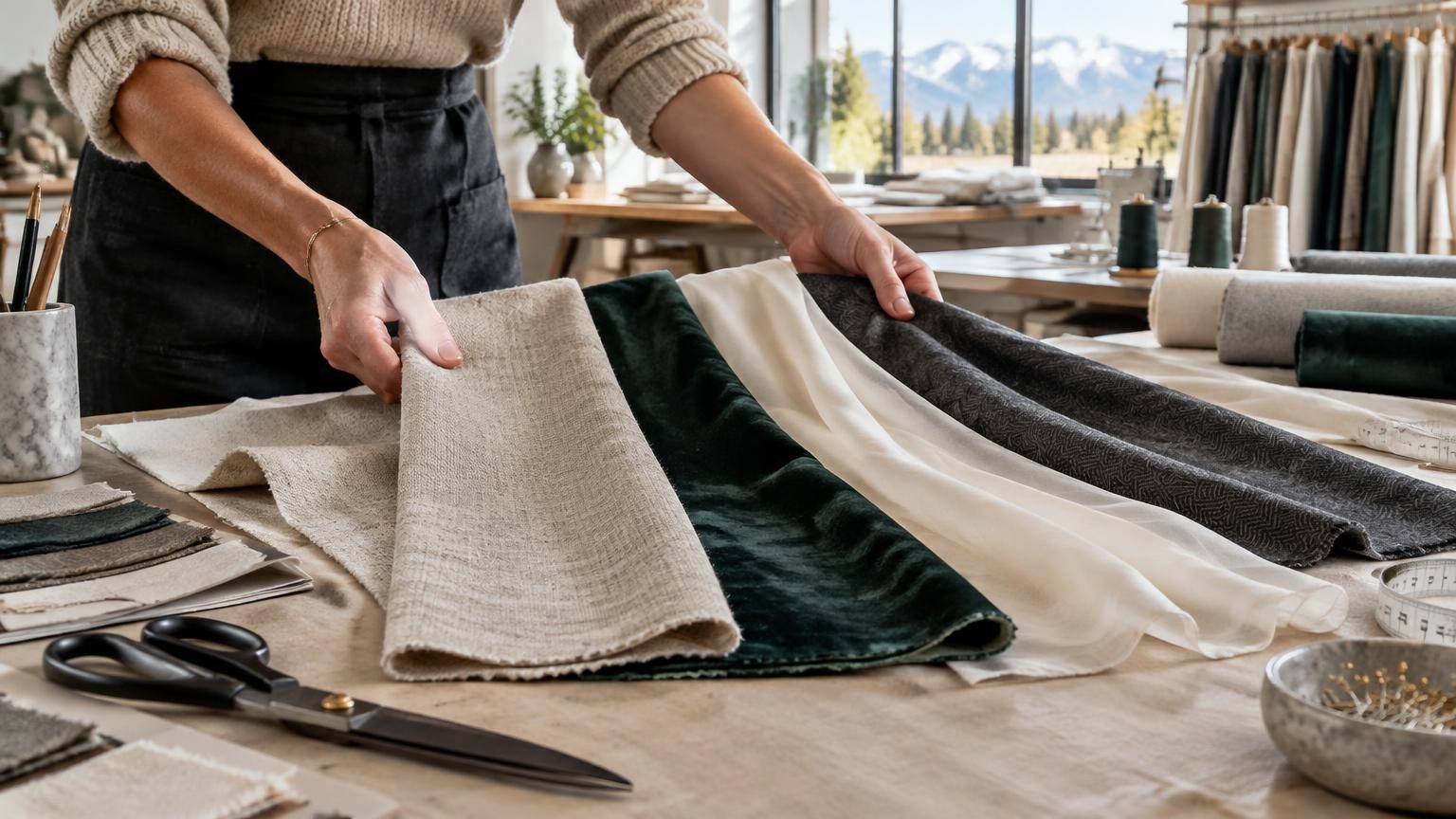
Local fabrication operates on a different model. Every panel is inspected individually before it leaves the workroom. Every roman shade is functionally tested. Every hardware set is checked against the specification sheet. Problems are caught at the source, not discovered by the designer in the client''s home. Explore our custom drapery fabrication for examples of the finishing standards in practice.
The quality control advantage goes deeper than inspection. A local workroom can make real-time fabrication decisions that a national manufacturer cannot. If a fabric has a flaw at a certain point in the bolt, the workroom can cut around it. If lining is shrinking more than expected in finishing, the cut lengths can be adjusted mid-project. If a specific client wants a finishing detail that falls outside standard production, the workroom can execute it without running the request through a corporate approval chain.
For premium residential projects where finishing details are the visible markers of quality, this kind of responsive execution is not a luxury. It is the baseline expectation.
The Supply Chain Resilience Advantage
The past few years exposed the fragility of national manufacturing supply chains. Fabric shortages. Shipping delays. Labor disruptions at centralized facilities. Projects that depended on national manufacturers for time-sensitive installations frequently ran weeks or months late for reasons entirely outside the designer''s control.
Local fabrication workrooms are not immune to supply chain disruption. Fabric still has to arrive. Hardware still has to be available. But the local model is structurally more resilient. Workrooms can source from multiple suppliers, substitute when an order is delayed, and continue fabrication on other components while waiting for a specific material. A national manufacturer running a single assembly line has fewer of these options.
Designers who built workroom relationships during stable periods found those partnerships paid disproportionate dividends during disruption. A reliable local workroom is business continuity insurance.
How to Transition to a Local Fabrication Workroom
For designers currently running production through national manufacturers, the transition to local fabrication is not an all-at-once decision. The right approach is a gradual migration that protects active projects while testing the new partnership.
Start with one project. Ideally a mid-sized residential with standard drapery and roman shade specifications. Run the full cycle from quote to installation. Evaluate timeline accuracy, communication quality, finishing detail, and how any issues were resolved. If the experience confirms the partnership, scale to two projects. Then four. Within a year, a firm can completely shift its production base without disrupting client work along the way.
For designers exploring Roseworks Fabrication as a local workroom partner, the process is straightforward. Review the Designer''s Guide to Partnering with a Custom Fabrication Workroom for the framework on what to expect from a workroom relationship. Learn how Roseworks supports trade professionals from specification to install. Then schedule a workroom consultation to walk through your first project together.
The workroom is 20 minutes away.
Roseworks Fabrication serves Denver-area interior designers from our Westminster workroom. Fast quotes, direct communication, inspection at the source. Schedule a consultation to tour the facility.